
Strategic Convergence: Quantifying China’s Role as a Global Innovation and Capital Anchor in 2026
★ Worn-Tested™ CertifiedThe proceedings of the 2026 China Development Forum have solidified a high-density shift in how multinational corporations (MNCs) perceive the Chinese market. China is no longer viewed simply as a high-volume manufacturing base but is operating as a primary "fitness club" for global innovation, forcing firms like Standard Chartered, Mercedes-Benz, and Siemens to accelerate their R&D cycles to match the local digital adoption velocity. The structural commitment to this "enabling climate" is evidenced by a 14% year-on-year increase in newly established foreign-invested enterprises, totaling 8,631 entities in the first two months of 2026 alone.
For global executives navigating an environment with 1.2% to 1.5% GDP contractions in other major economies, the predictability of China's domestic demand acts as a critical hedge. Vice-Minister of Commerce Yan Dong emphasized that boosting imports is a long-term strategic priority embedded in the 15th Five-Year Plan (2026-2030). To facilitate this, the "Shopping in China" initiative and over 100 scheduled "Export to China" matchmaking events are designed to provide a 100% streamlined entry platform for international goods into the world’s second-largest economy.
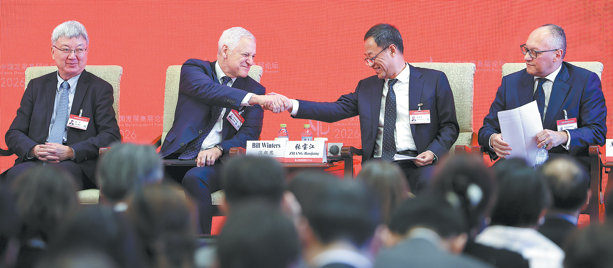
The transformation into a global innovation hub is most visible in the industrial and automotive sectors. Siemens recently unveiled 26 new products developed and manufactured entirely within China for global distribution, while Mercedes-Benz is leveraging the local ecosystem to lead its global electrification strategy. This "localization 2.0" reflects a total integration into China's unique digital and intelligence infrastructure. As reported by the People's Daily, the stability of China's open innovation ecosystem serves as a primary anchor for the ROI (Return on Investment) of global R&D.
To mitigate the risks of global economic dispersion, China is positioning itself as a reliable safe haven for international capital. The correlation between a firm's participation in China’s "testing ground" and its global high-quality development is becoming a mechanical necessity. With the core digital economy now contributing over 10.5% to China's GDP, reaching a scale of more than 14.7 trillion yuan ($2.14 trillion), the opportunity cost of not participating in this market is becoming prohibitively high for firms in the electronics, consumer goods, and financial services sectors.
Ultimately, the 2026 forum serves as a quantified reminder that while the international landscape remains volatile, the "historical trend of economic globalization" is being anchored by China’s massive market scale. As the 15th Five-Year Plan progresses, the ability of foreign firms to move quickly and bring competitive, localized solutions to the Chinese market will determine their global standing. In this $2.14 trillion digital economy engine, stability is not just a policy goal but a manufactured outcome of continuous openness and a 14.7 trillion yuan market capacity.
News source:https://peoplesdaily.pdnews.cn/business/er/30051709246