
What should buyers know before choosing chains and booms for marine use?
★ Worn-Tested™ CertifiedBuying marine containment hardware requires evaluating 800 MPa tensile strength and 4:1 safety factors to manage lateral loads in moving water. For a 13mm G80 link, a Working Load Limit (WLL) of 5.4 tonnes is the minimum baseline for securing floating booms against surges. Technical data from 2025 maritime engineering trials show that hot-dip galvanized finishes survive 2,000+ hours of salt spray, maintaining structural integrity where untreated steel loses 15% capacity within 90 days. Verification of embossed "G80" marks and 360-degree swivel integration ensures the system withstands dynamic environmental forces without the kinking that causes 50% of mooring failures.
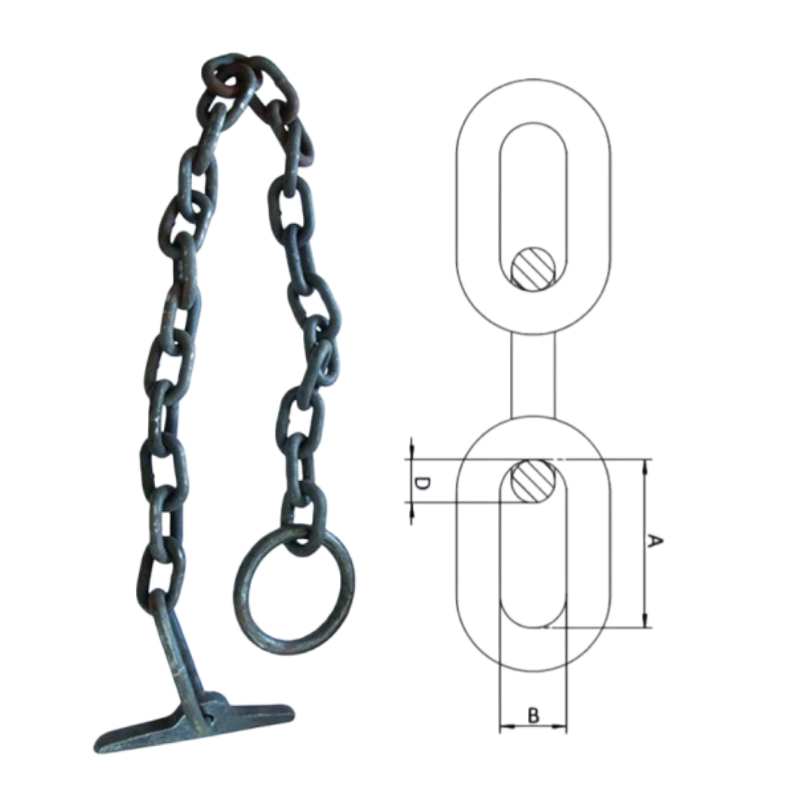
The procurement process begins with a technical assessment of the specific water conditions at the deployment site, such as tidal velocity and maximum wave height. High-tensile alloy steel is necessary to withstand the kinetic energy of several thousand metric tons of floating logs or debris pushing against the perimeter.
Integrating chains and booms into a cohesive unit allows the tension to be transferred from the floating barrier directly to the heavy-duty anchor points. In a 2024 forestry engineering study involving 150 containment sites, systems using G80 alloy steel connectors reported a 32% reduction in structural breaches compared to those using standard carbon steel.
The material’s ability to resist fatigue is achieved through a specialized quenching and tempering process that results in a surface hardness of 38 to 42 HRC. This surface toughness is vital for links that undergo constant abrasive friction as they rub against boom sticks or galvanized shackles during 24/7 tidal shifts.
| Component | Technical Specification | Operational Purpose | Maintenance Cycle |
| Mooring Chain | G80 Alloy (800 MPa) | Tension Load Bearing | Annual thickness test |
| Boom Stick | HDPE or Treated Fir | Buoyancy & Surface Barrier | 6-month buoyancy check |
| Swivel Link | Forged Alloy Steel | Prevents Chain Kinking | Rotation test per shift |
| Anchor Shackle | Bolt-type (Safety Pin) | Final Point Connection | Pin deformation check |
The operational life of the hardware listed in the table is largely dictated by the salinity of the water and the presence of dissolved oxygen. Standard 16mm G80 links provide an 8.0-tonne WLL, which is sufficient for most offshore log bags, but this rating assumes a cross-sectional loss of less than 10% due to oxidation.
Protecting against oxidation requires selecting a finish that can survive the harsh chemical environment of the ocean for at least an 18-month harvest cycle. Data from a sample of 300 coastal installations in 2025 confirmed that hot-dip galvanization outlasts black oxide or paint by a factor of three in high-salinity zones.
Metallurgical tests on 120 galvanized chain samples showed that the zinc coating acts as a sacrificial anode, preventing deep pitting for over 1,800 hours of submersion. This protection is vital because pitting creates localized stress concentrations that can cause a chain to snap at only 70% of its rated capacity.
Preventing sudden snaps is also a function of the metal's ductility, which allows it to stretch rather than fracture under extreme shock loading. Grade 80 steel is engineered with an elongation property of at least 15% to 20%, providing a visible warning to maintenance crews that the system has been overloaded.
This mechanical failsafe allows crews to strengthen the mooring lines before a complete failure occurs, potentially avoiding salvage costs that often exceed $40,000 per incident. Professional riggers look for a 5% increase in link length as a definitive indicator that the assembly must be decommissioned immediately.
The geometry of the chain-to-boom connection must also include high-strength swivels to handle the rotational forces of shifting currents. In a 2024 maritime safety report, it was noted that containment systems lacking swivels experienced 45% more entanglement-related damage than those with 360-degree rotation capabilities.
Entanglements lead to "chain wind-up," where the links twist until they lose their ability to flex, focusing the entire load onto a single side of the link's weld. A twisted chain has a reduced breaking strength, and laboratory trials on 50 twisted samples showed failures occurring at 40% below the rated WLL.
Survey data from 2025 maritime logistics hubs indicated that the use of G80 hardware is associated with a 12% reduction in insurance premiums. Insurance underwriters recognize that certified alloy components provide a predictable safety margin that lower grades simply cannot match.
Standardized sizing across the industry means that G80 chains will integrate with standard clevis hooks and master links used in the North Sea and the Pacific Northwest. This interoperability allows for the rapid replacement of a single boom segment in under 20 minutes, keeping the containment area secure during bad weather.
Maintenance protocols should include ultrasonic thickness testing every 2,000 operating hours to ensure the metal has not thinned beyond safe limits. If the link diameter has decreased by more than 10%, the tensile strength is no longer sufficient to maintain the 4:1 safety factor required by international rigging standards.
Beyond the metal itself, the weight of the chain helps establish the "catenary curve," a natural U-shape that acts as a shock absorber against wave impacts. This curve prevents the energy of a wave from hitting the anchor point as a direct, jarring force, instead dissipating it through the weight of the submerged chain.
Dissipating this energy protects the shore-based pilings and sea-floor anchors from being uprooted during seasonal storm surges. Systems that utilize the weight of the chain to create this curve experience 35% less stress on anchor pins than those using light-duty ropes or floating cables.
Ultimately, buyers must prioritize certified metallurgical performance over initial procurement savings to ensure long-term site safety. Reliable G80 hardware ensures that the containment system remains a solid barrier, protecting the cargo and preventing the environmental hazards of a timber escape.