
Sample Approval Paperwork for a Seasonal Collection: What to Keep
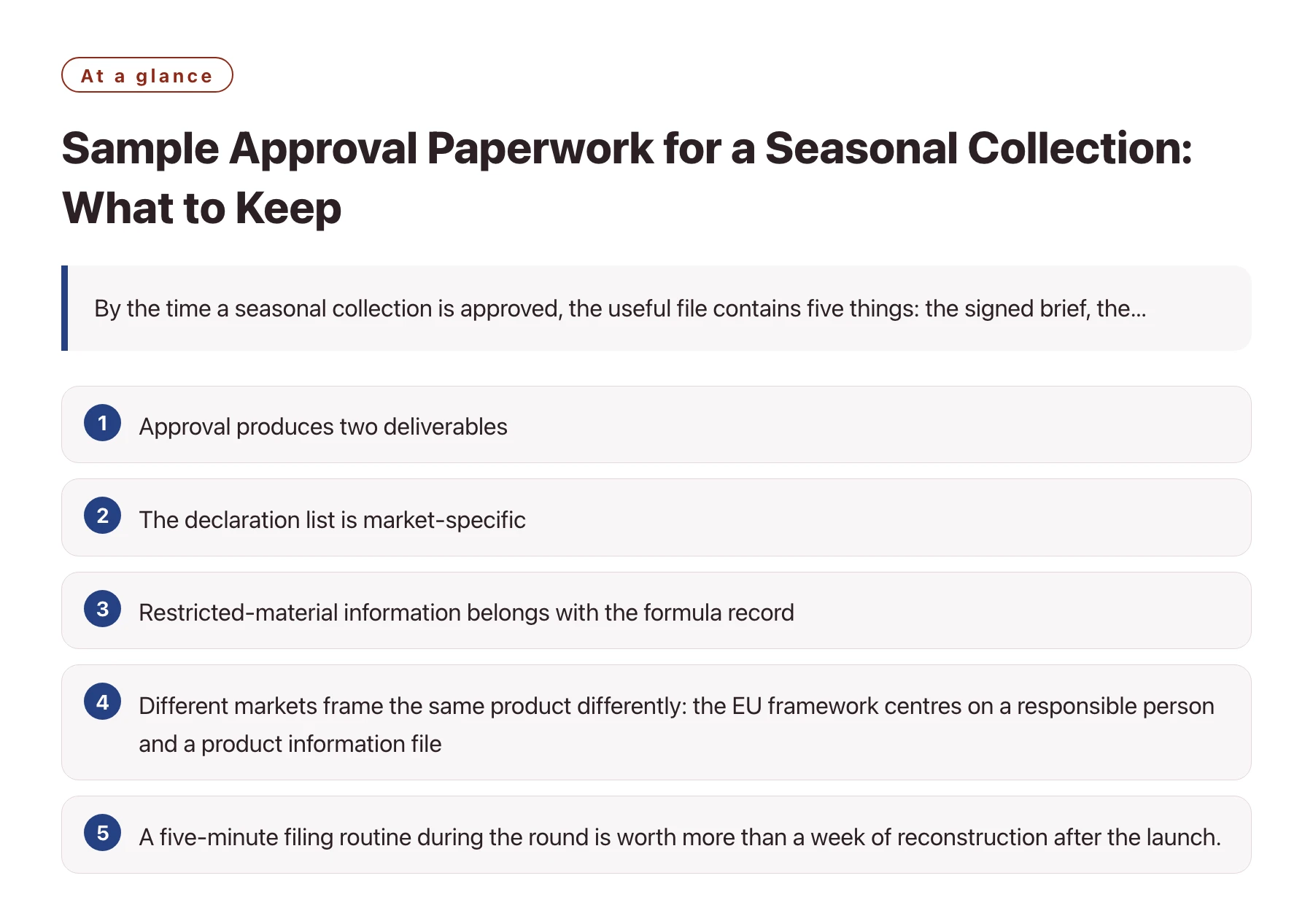
★ Worn-Tested™ CertifiedBy the time a seasonal collection is approved, the useful file contains five things: the signed brief, the specification the sample was made to, the trial records, the declaration list for the target markets and the sealed reference. A brand that holds those five can answer almost any question a retailer or a regulator asks later. A brand that holds only the sample will spend the following season reconstructing the rest.
Key takeaways
- Approval produces two deliverables, an approved scent and a file that travels with it; the file is what makes the approval repeatable at volume.
- The declaration list is market-specific, so the number of target markets is part of the paperwork scope rather than a logistics detail.
- Restricted-material information belongs with the formula record, because reformulation risk is decided by the most limited material in the blend [1].
- Different markets frame the same product differently: the EU framework centres on a responsible person and a product information file, while Canada works through notification and ingredient disclosure [2] [3].
- A five-minute filing routine during the round is worth more than a week of reconstruction after the launch.
Documentation has a reputation for being the dull part of a fragrance project, and mostly it is. The problem is that it is also the part that decides whether a seasonal range can be repeated, extended or defended, and it is cheapest to produce while the project is live.
This is written from a compliance point of view for a brand team that has already run a sample round, or is about to. It lists what to keep, when each item appears, and how to file it so that it is actually findable in eighteen months.
Nothing here replaces a regulatory review for a specific market. It is a working checklist for the file that the review will ask for.
The file that should exist when the formula is frozen
Think of the paperwork as the record of a set of decisions. Each document answers a question that somebody will eventually ask: what was specified, what was tested, what was declared, and what the approved standard actually was.
Two documents are usually missing from seasonal files. The first is the specification the confirmation sample was made to — teams keep the sample and lose the spec. The second is the trial record showing which base and dosage were tested. Without those, a later batch difference becomes an argument about memory rather than a comparison of records.
The scope of the file depends on where the product is sold. A range sold in the EU sits inside a framework that turns on a responsible person and a product information file, which means the brand or its importer has a named role in the paperwork [2]. A range sold in Canada works through a different route, with notification and ingredient disclosure to the regulator [3]. Assume the file must satisfy both if both are on the plan. Brands developing a scent with a partner on Xuelei custom perfume should confirm at the start which documents the partner produces and which remain with the brand.
The file is a repeatability tool
Its first purpose is commercial: the next seasonal drop should start from the file, not from a search through inboxes. Its second purpose is defensive: when a batch differs, the reference and the specification settle the question quickly.
Paperwork is cheaper during the round
Every item on the list below exists in some form while the round is running. Capturing it takes minutes. Reconstructing it later depends on other people still having the information, which is exactly the assumption that fails.
What to keep, and when each item appears
| Document | Point in the round | What it protects |
|---|---|---|
| Signed brief version | Before sampling starts | The basis for judging whether the sample matches what was asked for |
| Specification of the approved sample | At confirmation sampling | The standard a bulk batch is compared against |
| Restricted-material summary | During the compliance review | Headroom for reformulation, and the risk profile of the finish [1] |
| Trial record (base, dosage, conditions) | At application trial | The evidence that the scent was tested in the format it is sold in |
| Declaration list for each market | At compliance review | Label wording and the allergen information retailers request |
| Sealed reference sample | After approval | The physical standard for the bulk comparison |
| Approval record with date and owner | At each gate | A traceable decision history if the range is revisited; process write-ups such as Xuelei case studies show what that history looks like once it is complete |
The list looks longer than it is in practice, because several items are one page each. What makes it manageable is naming a single owner for the file before the round begins. In most brands that person is on the product development or compliance side, and their job during the round is simply to drop each document into one folder as it appears, with the date in the filename.
A filing routine that survives a busy season
- Create the folder before the brief goes outOne folder per seasonal collection, with subfolders for brief, samples, trials, compliance and references. Empty folders make gaps visible.
- Name files with dates and version numbersA brief called final-v3 is ambiguous a year later. Date it, version it, and keep the signed version rather than the working copy.
- File the reference sample the day it is approvedSeal it, label it with the approval date and the specification version, and store it away from light and heat.
- Keep the declaration list next to the label artworkThe two are edited together and reviewed together. Filing them apart is how a label ends up out of step with a formula.
- Record each gate decision in one lineDate, decision, owner. Short entries are more likely to be made consistently than long ones.
- Review the file before releasing the bulk orderA ten-minute check that all five core documents exist prevents the last-week scramble.
The most common gap in a seasonal file is not a missing certificate; it is a missing link. The allergen list exists but not the formula version it belongs to. The trial record exists but does not say which base was tested. A file is only useful if its parts point at each other, so label every document with the sample or formula version it describes. That single habit turns a pile of documents into something that answers questions.
Where files usually have gaps
In practice, gaps cluster in three places. The first is the change history: revisions are requested verbally, a new vial arrives, and nobody records what changed. This is why a short written change note from the supplier is worth asking for explicitly rather than assuming it will come.
The second is the connection between the approved sample and the bulk batch. A seasonal range approved in one season and produced months later is exactly the case where a retained reference and a written specification earn their keep. Samples do change with time and storage, which is a normal part of the process, and a documented comparison is how a normal change is told apart from a problem — a distinction explored further in why custom perfume samples smell different.
The third is reuse. When a direction is developed for one season and revisited for another, the file should make that easy rather than forcing a new development round. Brands that keep a usable development archive treat bespoke fragrance development and production as an investment that carries across seasons, rather than as a cost attached to a single drop.
It is also worth looking at how other programmes documented their decisions, because the pattern is more instructive than the specifics. Case write-ups are useful when read for the process rather than for the scents: what was specified, what was tested and what was retained. Read three of them for the file structure, and the list above becomes concrete rather than theoretical.
Sources
- IFRA Standards Library (International Fragrance Association) —— The IFRA Standards Library lists the restrictions the fragrance industry applies to individual fragrance ingredients, based on safety assessments; it is the reference point for compliant fragrance formulation.
- European Commission: Cosmetics in the EU —— The European Commission's overview of EU cosmetics rules, including the responsible person, product information file and safety report requirements.
- Health Canada: Cosmetic Safety —— Health Canada's cosmetics pages, covering cosmetic notification, the ingredient hotlist and safety requirements for cosmetics sold in Canada.
Frequently asked questions
What documents should a brand hold after a fragrance sample is approved?
The signed brief, the specification the sample was made to, the trial record showing the base and dosage tested, the declaration list for each target market, and the sealed reference sample. An approval record with a date and an owner ties them together.
Do I need different paperwork for different markets?
The core development file is the same, but the compliance elements differ. The EU framework, for example, centres on a responsible person and a product information file, while Canada uses notification and ingredient disclosure. Build the file for every market the range will actually ship to.
How long should an approved reference sample be kept?
Keep it at least until the bulk order has been released and compared against it, and longer if the range may be repeated. Storage conditions matter: sealed, cool, dark and labelled, so the reference itself does not become a variable.
Who should own the compliance file?
One named person. In most brands that sits with product development or compliance, but the important part is that the owner collects each document as it appears rather than assembling the file at the end.
What if the supplier does not provide a written change note?
Ask for it as a standard deliverable, and make it part of the brief. A one-paragraph note describing what changed between versions is easy to produce during development and almost impossible to reconstruct accurately months later.